Risks of Running ASIC Miners at Home

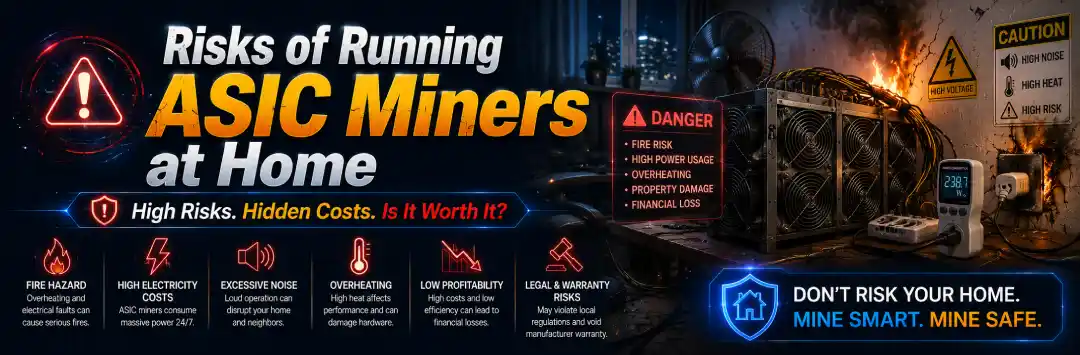
Many cryptocurrency miners begin their mining journey by operating ASIC miners at home. While this approach may appear simple and cost-effective at first, home-based mining introduces several challenges that can affect profitability, equipment lifespan, safety, and overall mining performance.
As ASIC hardware becomes more powerful and energy-intensive, an increasing number of miners are moving away from residential setups and choosing professional ASIC mining hosting in Thailand instead.
Why Home Mining Appears Attractive
For new miners, operating equipment at home can seem convenient.
Common reasons include:
- Immediate access to equipment
- No hosting fees
- Full control over operations
- Simple initial deployment
However, many investors discover that operating ASIC miners at home becomes increasingly difficult as mining operations grow.
High Electricity Consumption
Modern ASIC miners consume substantial amounts of electricity continuously.
Many industrial-grade mining machines require between 3,000 and 4,000 watts of power while operating twenty-four hours a day.
Running multiple machines at home can create challenges such as:
- Higher electricity bills
- Increased circuit loads
- Electrical safety concerns
- Potential breaker trips
- Power distribution limitations
Residential electrical systems are often not designed for continuous industrial-level power consumption.
Excessive Heat Generation
One of the most underestimated problems in home mining is heat.
ASIC miners convert large amounts of electrical energy into heat during operation.
Without proper cooling, indoor temperatures can rise significantly.
This can result in:
- Uncomfortable living conditions
- Reduced mining efficiency
- Thermal throttling
- Shortened hardware lifespan
- Higher cooling expenses
Professional facilities are specifically designed to manage heat through industrial ventilation and airflow systems.
Noise Levels Can Be Extreme
ASIC miners are not quiet devices.
High-speed cooling fans generate significant noise during continuous operation.
Depending on the machine model, noise levels can exceed those of common household appliances.
Common issues include:
- Sleep disruption
- Reduced comfort
- Family complaints
- Neighbor concerns
- Limited installation locations
Many home miners eventually discover that constant fan noise becomes one of the most difficult aspects of residential mining.
Limited Cooling Infrastructure
Most homes are not designed to support industrial mining equipment.
ASIC miners require effective airflow and ventilation to maintain stable operating temperatures.
Without proper cooling infrastructure, miners may experience:
- Higher operating temperatures
- Increased fan wear
- Reduced efficiency
- Unexpected shutdowns
- Hardware degradation
Professional hosting facilities invest heavily in cooling systems because temperature management directly affects uptime and equipment longevity.
Electrical Safety Risks
Continuous high-power consumption places additional stress on residential electrical systems.
Poor electrical planning can increase risks including:
- Overloaded circuits
- Damaged wiring
- Power instability
- Equipment failures
- Fire hazards
Before operating multiple ASIC miners at home, investors should carefully evaluate whether their electrical infrastructure can safely support the load.
Reduced Uptime and Operational Stability
Mining profitability depends heavily on uptime.
Home environments often lack the infrastructure required to maintain continuous operation.
Common causes of downtime include:
- Power interruptions
- Internet outages
- Overheating
- Hardware failures
- Delayed maintenance
These issues can significantly reduce mining performance over time.
Investors interested in operational reliability can also review why uptime matters in ASIC mining operations.
Maintenance Becomes Time-Consuming
ASIC miners require ongoing maintenance to perform efficiently.
Home operators are responsible for:
- Cleaning dust buildup
- Monitoring temperatures
- Replacing fans
- Troubleshooting hardware issues
- Managing firmware updates
As the number of machines increases, maintenance demands can quickly become difficult to manage.
Security Concerns
ASIC miners represent valuable hardware assets.
Residential environments typically offer less security than dedicated mining facilities.
Potential risks include:
- Unauthorized access
- Theft
- Accidental damage
- Environmental exposure
Professional hosting facilities often provide controlled access, surveillance systems, and inventory management procedures designed to protect mining equipment.
Scaling Is Difficult
Operating one or two ASIC miners at home may be manageable.
Scaling to larger deployments introduces significant challenges.
Expansion often requires:
- Additional electrical capacity
- Improved ventilation
- Dedicated space
- Enhanced cooling systems
- More maintenance resources
Many miners eventually reach a point where residential infrastructure becomes the primary limitation.
Professional Hosting as an Alternative
Professional hosting facilities are specifically designed to solve many of the problems associated with home mining.
Typical benefits include:
- Industrial electrical infrastructure
- Professional cooling systems
- Remote monitoring tools
- Technical support teams
- Higher uptime
- Scalable deployment options
Investors can learn more about Thailand mining infrastructure and how professional facilities support large-scale mining operations.
What Experienced Miners Usually Prioritize
As mining operations mature, investors often focus on factors beyond electricity pricing.
Important considerations include:
- Operational stability
- Infrastructure reliability
- Cooling efficiency
- Technical support
- Equipment protection
- Long-term scalability
These factors frequently have a greater impact on profitability than many new miners initially expect.
Is Home Mining Worth the Risk?
Home mining can be a useful starting point for learning about ASIC operations, but it also introduces significant operational challenges.
As power consumption, heat generation, maintenance requirements, and scalability demands increase, many investors eventually transition to professional hosting environments.
For miners seeking long-term operational efficiency, higher uptime, and easier expansion, professional hosting facilities often provide a more practical solution than running industrial ASIC miners at home.
For additional information about Bitcoin mining and ASIC hardware technologies, investors can visit Bitcoin.org and Bitmain.