Thailand vs USA Mining Hosting: Which Is Better for ASIC Mining?

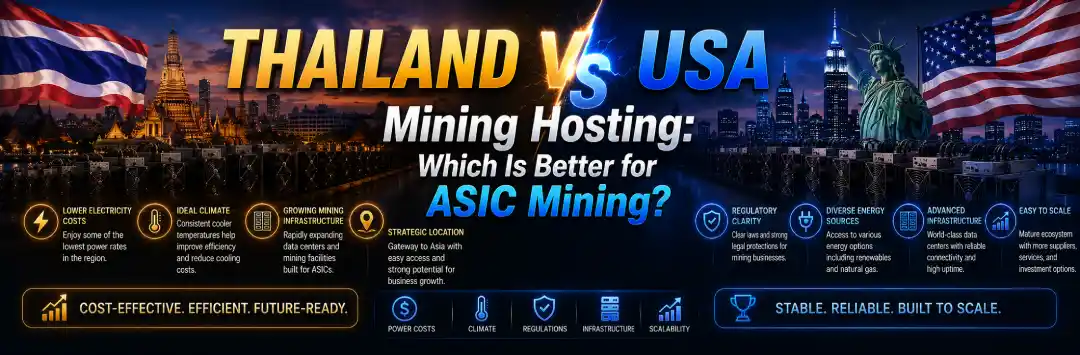
The United States has become one of the world’s largest Bitcoin mining markets, attracting industrial-scale operators with vast infrastructure investments and access to energy resources. At the same time, Thailand has emerged as a growing mining destination in Southeast Asia, offering a different combination of infrastructure, operational costs, and hosting flexibility.
For international investors evaluating mining locations, understanding the strengths and limitations of each country is essential before committing capital and equipment.
Those considering ASIC mining hosting in Thailand often compare the country’s advantages against established mining markets such as the United States.
Why Compare Thailand and the USA?
Both countries offer professional hosting environments, but they serve different types of mining investors.
When comparing mining destinations, investors should evaluate:
- Electricity costs
- Infrastructure quality
- Technical support
- Facility scalability
- Operational stability
- Internet connectivity
- Logistics efficiency
- Long-term operating costs
Successful mining operations are built on a combination of these factors rather than electricity pricing alone.
Electricity Costs
The United States offers access to a wide range of electricity markets. Depending on location, some industrial mining operations benefit from competitive energy pricing, particularly in regions with abundant energy production.
However, electricity costs vary significantly between states and utility providers.
Thailand may not always offer the lowest global power rates, but many professional hosting facilities provide predictable operating environments and competitive industrial pricing structures.
Investors should focus on total operational costs rather than comparing electricity prices in isolation.
For detailed planning, miners can review electricity cost for ASIC mining in Thailand.
Infrastructure Quality
The United States has extensive industrial infrastructure and hosts some of the world’s largest mining facilities.
Thailand, while operating on a smaller overall scale, offers modern infrastructure that supports industrial ASIC hosting operations.
Important infrastructure considerations include:
- Power reliability
- Cooling systems
- Network stability
- Facility management
- Monitoring systems
- Technical staffing
Investors evaluating hosting environments should consider how infrastructure contributes to uptime and operational efficiency.
Additional information can be found in our guide to Thailand mining infrastructure.
Operating Costs Beyond Electricity
Electricity is only one part of mining expenses.
Other operational costs may include:
- Facility management
- Technical support
- Equipment maintenance
- Cooling infrastructure
- Security systems
- Remote monitoring services
Many investors discover that overall operational efficiency has a greater impact on profitability than electricity pricing alone.
Technical Support Availability
ASIC miners occasionally require diagnostics, maintenance, and repairs. Access to qualified technicians can significantly influence uptime.
The United States has an established mining industry with professional support services available in major mining regions.
Thailand has also developed a growing ecosystem of mining professionals and technical support providers serving domestic and international investors.
Important support capabilities include:
- Machine diagnostics
- Hash board troubleshooting
- Power supply replacement
- Cooling system maintenance
- Firmware support
- Preventive maintenance
Investors should evaluate available ASIC repair and technical support when comparing hosting locations.
Remote Monitoring and Fleet Management
Modern mining operations increasingly rely on remote management systems.
Whether machines are hosted in Thailand or the United States, investors expect access to real-time operational data.
Common monitoring capabilities include:
- Hashrate tracking
- Machine status monitoring
- Power consumption reporting
- Temperature monitoring
- Maintenance alerts
- Performance analytics
Remote visibility becomes especially important for international investors managing large ASIC fleets.
Investors can also explore remote monitoring for ASIC mining farms to understand how monitoring systems improve operational performance.
Uptime and Operational Reliability
Regardless of location, uptime remains one of the most important profitability factors in mining.
Every minute that machines remain offline represents lost mining opportunities.
Professional hosting facilities focus on:
- Stable power infrastructure
- Reliable network connectivity
- Cooling efficiency
- Preventive maintenance
- Rapid technical response
Maintaining high uptime often delivers greater financial benefits than marginal differences in electricity pricing.
For a deeper look at this topic, investors can review why uptime matters in ASIC mining operations.
Logistics and Geographic Advantages
The United States provides access to a large domestic market and extensive transportation infrastructure.
Thailand offers strategic advantages for investors operating throughout Southeast Asia.
Thailand’s regional location can simplify:
- Equipment deployment
- Regional expansion
- Cross-border logistics
- Technical support coordination
- Fleet management across Asia
For investors focused on the Asian market, Thailand may offer logistical advantages that support future growth.
Scalability for Large ASIC Deployments
Both Thailand and the United States can support large-scale mining operations.
Before choosing a location, investors should evaluate:
- Available power capacity
- Facility expansion options
- Technical workforce availability
- Cooling infrastructure
- Network capacity
- Long-term growth plans
Scalability is particularly important for investors planning to expand beyond their initial deployment.
Which Country Is Better?
The answer depends on the investor’s goals.
The United States offers one of the world’s largest mining ecosystems with extensive infrastructure and large-scale industrial facilities.
Thailand offers a balanced environment that combines modern infrastructure, professional hosting services, technical support, and strategic access to Southeast Asia.
For many investors, the decision comes down to whether they prioritize operating within a mature North American mining market or establishing a cost-efficient presence in a rapidly growing Asian region.
What Professional Miners Usually Evaluate
Experienced mining operators rarely make decisions based on electricity pricing alone.
They typically ask:
- How reliable is the infrastructure?
- What uptime levels can be achieved?
- How quickly can issues be resolved?
- Can operations scale efficiently?
- How effective is remote management?
- What are the long-term operational risks?
The answers to these questions often determine overall profitability more than any single operating cost.
Thailand’s Growing Role in Global ASIC Hosting
As cryptocurrency mining becomes increasingly global, investors are looking beyond traditional mining regions for new opportunities.
Thailand continues to attract attention because it combines infrastructure reliability, technical expertise, operational flexibility, and regional accessibility.
For investors seeking a professional hosting environment in Southeast Asia, Thailand offers a practical alternative to larger mining markets while maintaining the infrastructure standards required for industrial ASIC operations.
Those interested in expanding operations can also review mining opportunities for investors in Thailand.
For additional information about Bitcoin mining and ASIC hardware technologies, investors can visit Bitcoin.org and Bitmain.