Scaling From 10 to 1000 ASIC Machines: Why Infrastructure Matters More Than Hardware

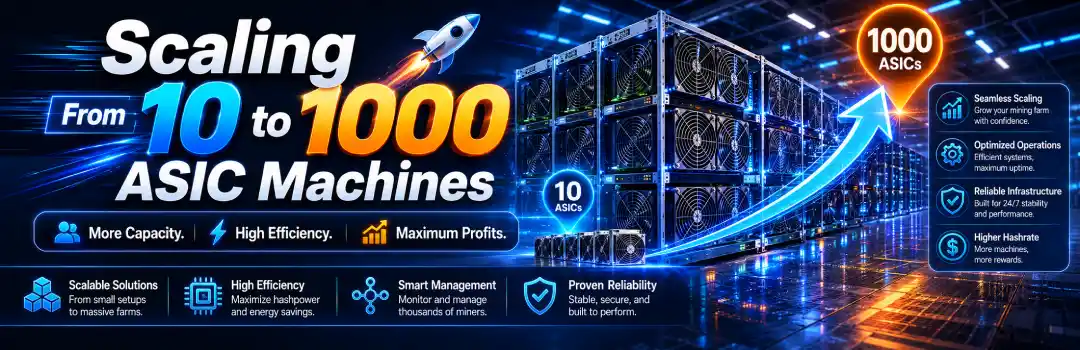
Many miners assume that scaling an operation simply means purchasing more ASIC machines. In reality, successful expansion depends far more on infrastructure than hardware itself.
Operating 10 ASIC miners is very different from managing 100, 500, or 1000 machines. As mining fleets grow, power distribution, cooling systems, maintenance procedures, monitoring platforms, and technical support become critical factors that directly affect profitability.
For investors considering ASIC mining hosting in Thailand, understanding these challenges can help reduce risk and support long-term growth.
The Mistake Many Growing Mining Operations Make
Many operators focus primarily on purchasing additional ASIC miners while underestimating infrastructure requirements.
As fleet size increases, operational complexity grows rapidly. More machines generate more heat, consume more electricity, require more maintenance, and increase the financial impact of downtime.
Without proper planning, adding more miners can reduce efficiency rather than improve profitability.
Stage 1: Operating 10 to 50 ASIC Miners
At this stage, most miners can still manage operations with limited infrastructure.
- Basic power management
- Manual monitoring
- Simple cooling systems
- Basic maintenance routines
- Direct hardware oversight
While operations remain relatively simple, many miners begin experiencing challenges related to noise, heat generation, and residential electricity limitations.
Stage 2: Scaling to 100 ASIC Miners
Once operations approach 100 machines, infrastructure requirements increase significantly.
Power demand rises substantially, cooling becomes more difficult, and manual monitoring becomes less practical.
- Electrical capacity planning
- Network reliability
- Facility airflow design
- Machine organization
- Preventive maintenance procedures
At this point, many operators begin evaluating professional mining facilities rather than expanding within residential environments.
Stage 3: Operating 250 to 500 ASIC Miners
Mining operations at this scale become increasingly dependent on professional infrastructure.
Even minor inefficiencies can create significant financial losses when multiplied across hundreds of machines.
- Industrial power systems
- Centralized monitoring platforms
- Dedicated technical support
- Inventory management
- Repair workflows
- Cooling optimization
Successful operators understand that uptime becomes one of the most important drivers of profitability.
Stage 4: Managing 1000 ASIC Miners
A 1000-machine deployment operates more like an industrial facility than a traditional mining operation.
At this scale, infrastructure becomes the foundation of business performance.
- Megawatt-level power management
- Redundant electrical systems
- Professional maintenance teams
- Remote monitoring platforms
- Asset management systems
- Expansion planning
The difference between a well-managed operation and an inefficient facility can represent a substantial difference in monthly revenue.
Why Downtime Becomes Expensive at Scale
When operating ten machines, temporary downtime may have limited impact.
When operating hundreds or thousands of ASIC miners, even small disruptions can significantly reduce mining output.
This is why large-scale operators prioritize:
- Power reliability
- Cooling efficiency
- Rapid repair response
- Continuous monitoring
- Preventive maintenance
Many investors review why uptime matters in ASIC mining operations before making expansion decisions.
Why More Operators Are Choosing Professional Hosting
Building and managing private mining infrastructure requires significant capital investment and ongoing operational expertise.
Rather than constructing new facilities, many mining operators now choose professional hosting environments that already provide:
- Industrial-grade electrical infrastructure
- Optimized cooling systems
- 24/7 monitoring
- Technical support teams
- Maintenance services
- Scalable expansion capacity
This allows investors to focus on growing their mining fleets while reducing operational complexity.
Why Thailand Is Emerging as a Mining Hosting Destination
Thailand continues to attract interest from international mining operators seeking infrastructure stability and long-term operational scalability.
Modern facilities offer reliable power systems, professional technical support, equipment maintenance services, and growing hosting capacity for industrial-scale deployments.
Investors evaluating relocation opportunities often compare Thailand vs Laos mining hosting when assessing long-term operational risks and infrastructure quality.
As mining operations continue to scale, infrastructure quality increasingly becomes more important than hardware quantity alone.
Growing from 10 ASIC miners to 1000 machines requires more than purchasing additional hardware. Successful expansion depends on power infrastructure, cooling systems, monitoring capabilities, maintenance procedures, and operational discipline.
Operators who prioritize infrastructure, uptime, and scalability often achieve stronger long-term results than those focused solely on increasing machine count.
For mining investors planning future expansion, professional hosting environments can provide the foundation necessary to support sustainable growth at scale.
For additional information about Bitcoin mining and ASIC hardware technologies, visit Bitcoin.org and Bitmain.