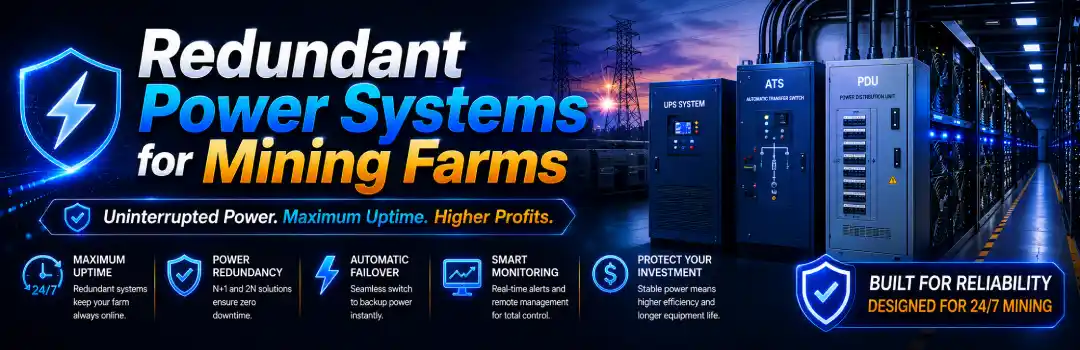
Redundant Power Systems for Mining Farms

Power reliability is one of the most important factors in cryptocurrency mining. ASIC miners are designed to operate continuously, and even short interruptions can reduce profitability, disrupt mining operations, and create unnecessary stress on hardware.
For this reason, professional mining facilities often invest in redundant power systems to improve operational stability and reduce the risk of downtime.
For investors considering ASIC mining hosting in Thailand, understanding power redundancy is an essential part of evaluating mining infrastructure.
What Is a Redundant Power System?
A redundant power system is an infrastructure design that provides alternative power pathways and backup protection to minimize disruptions when a primary power source experiences issues.
Instead of relying on a single point of failure, redundant systems help maintain operational continuity when unexpected events occur.
Depending on facility design, redundancy may include:
- Multiple power feeds
- Backup generators
- Automatic transfer systems
- Power monitoring equipment
- Redundant distribution systems
- Surge protection systems
The objective is simple: keep ASIC miners operating as consistently as possible.
Why Power Stability Matters in Mining
Every ASIC miner generates revenue only while actively mining.
When power interruptions occur, mining immediately stops. Depending on the situation, machines may require manual inspection, rebooting, or troubleshooting before normal operation resumes.
Power instability can lead to:
- Lost mining revenue
- Reduced uptime
- Unexpected machine restarts
- Hardware stress
- Operational inefficiencies
This is why professional mining operators treat power infrastructure as a critical business asset.
Single Point of Failure Risks
One of the biggest dangers in mining operations is relying on a single power source.
If a critical component fails, the entire mining operation may be affected.
Potential single points of failure include:
- Main electrical feed
- Power distribution panels
- Circuit protection devices
- Networked control systems
- Electrical transformers
Redundant system design helps reduce dependence on individual components.
Backup Power Generators
Many industrial facilities use backup generators as part of their redundancy strategy.
When a utility power interruption occurs, generators can help maintain critical operations.
Benefits include:
- Reduced downtime
- Operational continuity
- Protection against unexpected outages
- Improved facility resilience
Generator systems are commonly used in data centers, industrial facilities, and professional mining farms.
Automatic Transfer Systems
Automatic transfer systems are designed to switch between power sources when disruptions occur.
These systems help minimize response time and reduce operational interruptions.
Advantages include:
- Faster recovery
- Reduced manual intervention
- Improved operational reliability
- Enhanced power management
In professional environments, automation plays an important role in maintaining uptime.
Power Distribution Design
Effective power distribution is just as important as power generation itself.
Mining facilities must safely deliver electricity to hundreds or even thousands of ASIC miners.
Professional power distribution systems typically focus on:
- Load balancing
- Circuit protection
- Power monitoring
- Capacity planning
- Expansion capability
Proper design helps prevent overload conditions and improves overall system stability.
Investors evaluating Thailand mining infrastructure should examine how facilities manage electrical distribution.
Monitoring and Power Management
Modern mining farms rely heavily on monitoring systems to maintain electrical reliability.
Power monitoring allows operators to detect abnormalities before they become major problems.
Common monitoring capabilities include:
- Voltage tracking
- Current monitoring
- Power consumption reporting
- Load analysis
- Alarm notifications
- Historical performance records
These systems help facility operators make informed decisions and respond quickly when issues arise.
Power Redundancy and Uptime
Power redundancy is directly connected to uptime performance.
The fewer interruptions a mining farm experiences, the greater the opportunity for consistent revenue generation.
Facilities with strong redundancy planning often achieve:
- Higher operational uptime
- Improved machine availability
- Reduced operational risk
- More predictable performance
Investors interested in uptime optimization can also review why uptime matters in ASIC mining operations.
Protecting Expensive ASIC Hardware
ASIC miners represent significant capital investment.
Power quality issues such as voltage fluctuations and unexpected interruptions may increase stress on sensitive electronic components.
Redundant infrastructure helps create a more stable operating environment that supports long-term hardware reliability.
Benefits may include:
- Reduced equipment stress
- Longer hardware lifespan
- Fewer unexpected failures
- Lower maintenance requirements
Protecting equipment is often just as important as maintaining operational uptime.
Scalability Considerations
As mining farms expand, power requirements increase dramatically.
A system that supports twenty machines may not be sufficient for two hundred or two thousand machines.
Scalable power infrastructure should consider:
- Future capacity growth
- Distribution expansion
- Generator sizing
- Monitoring upgrades
- Operational flexibility
Planning for growth helps prevent expensive infrastructure limitations later.
Questions Investors Should Ask Hosting Providers
Before selecting a mining facility, investors should understand how power reliability is managed.
Useful questions include:
- Is power redundancy implemented?
- Are backup generators available?
- How is electrical load monitored?
- What is the facility’s uptime history?
- How quickly can power issues be addressed?
- Can infrastructure support future expansion?
The answers often reveal the maturity and professionalism of a mining operation.
Reliable Power Is the Foundation of Professional Mining
Electricity is more than an operating expense—it is the foundation of every mining operation.
Professional mining facilities invest in redundant power systems because operational continuity directly affects uptime, profitability, and equipment protection.
For investors seeking long-term stability, facilities with strong power infrastructure and redundancy planning often provide a significant advantage over environments that rely on a single power source.
Those evaluating professional hosting facilities can also explore how foreign investors can host ASIC miners in Thailand when comparing infrastructure standards.
For additional information about Bitcoin mining and ASIC hardware technologies, investors can visit Bitcoin.org and Bitmain.