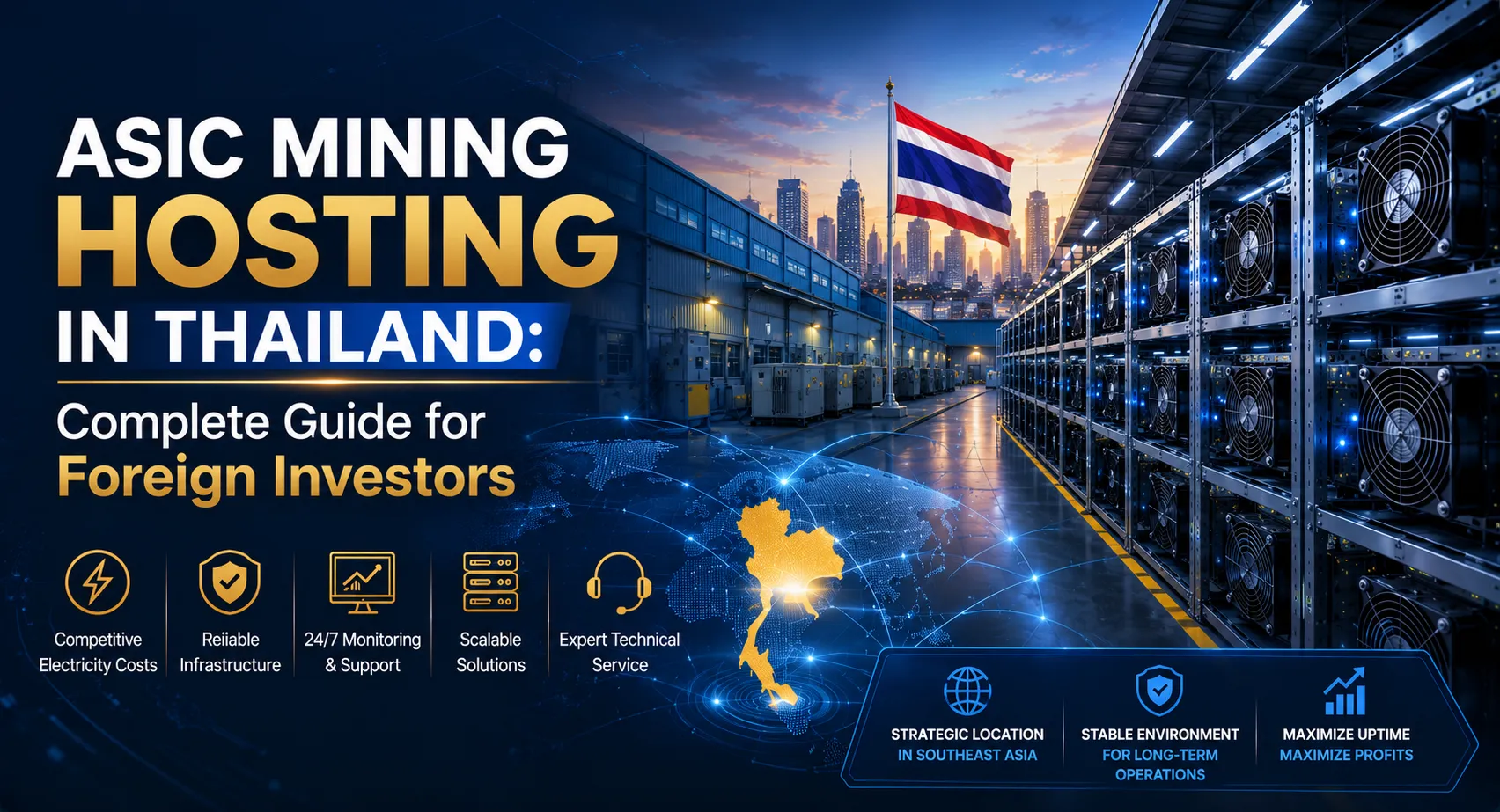
ASIC Mining Hosting in Thailand: Complete Guide for Foreign Investors

ASIC mining hosting allows investors to operate specialized cryptocurrency mining equipment inside a professionally managed facility instead of building and maintaining their own mining site. For international operators, this model can reduce the complexity of electricity management, heat control, internet connectivity, machine maintenance, physical security, and day-to-day technical support.
Thailand is increasingly considered by miners seeking a practical balance between operating cost, infrastructure quality, logistics, and access to experienced technicians. However, selecting a hosting location should never be based on electricity price alone. Long-term results depend on the complete operating environment: power stability, cooling efficiency, uptime, monitoring, maintenance response, contract transparency, and the provider’s ability to scale safely.
This guide explains how ASIC mining hosting in Thailand works, what foreign investors should evaluate, how professional facilities protect mining hardware, and which questions should be answered before machines are shipped or installed.
Quick Summary
- ASIC hosting separates equipment ownership from day-to-day facility operation.
- Foreign owners can retain control of their mining pool accounts and payout wallets.
- Power quality, cooling, monitoring, maintenance, and response time matter as much as the electricity rate.
- Thailand offers an established industrial-service base, regional logistics, and access to on-site technical support.
- A written agreement should define billing, repair authorization, uptime measurement, ownership records, insurance responsibility, and equipment release.
- Mining Prime supports individual miners and larger fleets through hosting, monitoring, maintenance, repair, and deployment services in Thailand.
What Is ASIC Mining Hosting?
ASIC mining hosting is a managed infrastructure service for application-specific integrated circuit miners. The investor owns or leases the mining equipment, while the hosting provider supplies the physical and operational environment required to run it continuously.
A professional hosting facility normally provides industrial electricity distribution, ventilation or cooling, internet connectivity, machine installation, pool configuration assistance, operational monitoring, basic maintenance, security, and technical response when a miner goes offline. Depending on the service agreement, the provider may also offer repair, parts replacement, cleaning, firmware support, inventory management, and performance reporting.
The arrangement is similar to equipment colocation, but mining hosting has requirements that conventional server colocation does not. ASIC miners consume substantial power, generate intense heat, produce high noise levels, move large volumes of air, and require rapid physical intervention when fans, power supplies, control boards, cables, or hashboards develop problems.
For these reasons, a facility suitable for ordinary servers is not automatically suitable for ASIC mining. The building, electrical system, airflow design, rack layout, network, safety procedures, and technical team must all be prepared for continuous high-density mining loads.
What the investor normally controls
- Ownership of the ASIC miners
- Mining pool account and wallet settings
- Choice of supported cryptocurrency and algorithm
- Worker names and pool configuration
- Performance targets and approved operating profile
- Decisions concerning repair, replacement, relocation, or sale
What the hosting provider normally manages
- Electrical connection and safe power distribution
- Cooling, ventilation, and heat removal
- Internet and local network infrastructure
- Installation, restart, inspection, and routine support
- Facility access, security, and inventory control
- Monitoring and reporting according to the service plan
ASIC Hosting Models Explained
The terms hosting, colocation, managed hosting, and remote mining are sometimes used interchangeably, but the level of service can differ substantially. Investors should understand the operating model before comparing prices.
| Hosting Model | Typical Provider Responsibility | Investor Responsibility | Best Suited For |
|---|---|---|---|
| Basic colocation | Rack space, electricity, internet, basic restart support | Configuration, monitoring, repair decisions, parts, optimization | Experienced operators with their own technical process |
| Managed ASIC hosting | Installation, monitoring, maintenance coordination, technical response | Pool and wallet control, commercial decisions, repair approval | Remote and foreign investors |
| Full-service mining operation | Equipment sourcing, deployment, hosting, monitoring, repair, reporting | Investment approval and strategic oversight | Investors seeking a single operational partner |
| Self-managed mining site | No third-party hosting responsibility | All power, cooling, staff, safety, network, repair, and security | Large operators with internal engineering capability |
Basic colocation may appear cheaper, but it can create hidden operational costs when there is no one available to diagnose failures, clean equipment, replace fans, inspect power supplies, or coordinate repairs. Managed hosting usually costs more because the provider assumes a greater share of the daily operating workload.
The correct choice depends on fleet size, technical experience, distance from the facility, expected response time, and how much operational control the investor wants to retain.
Why Investors Consider Thailand for ASIC Mining Hosting
Thailand is not attractive because of one single factor. Its value lies in the combination of infrastructure, regional logistics, technical capability, internet availability, industrial services, and access to established commercial systems.
Strategic location in Southeast Asia
Thailand is positioned near major Asian manufacturing, logistics, and technology markets. This can make equipment movement, replacement-part sourcing, and regional business coordination more practical than operating in a remote location with limited transport links.
Developed industrial ecosystem
Mining facilities depend on more than electricity. They require electrical engineers, technicians, industrial components, ventilation equipment, networking hardware, transportation, security, and maintenance services. Thailand has an established industrial and technical service base that can support these operational needs.
Reliable internet connectivity
ASIC miners do not require enormous bandwidth, but they do require consistent connectivity. A professional facility should maintain stable communication with mining pools, monitoring platforms, and remote management systems. Reliable connectivity also allows foreign owners to review hashrate, temperature, machine status, and maintenance activity without visiting the site.
Access to experienced technicians
When a miner stops hashing, the problem may involve a fan, power supply, control board, network setting, cable, firmware, sensor, or hashboard. A local team capable of physical inspection can reduce the time between fault detection and corrective action.
Balance between cost and operational control
The lowest advertised electricity price does not always produce the lowest effective mining cost. If cheap power is combined with poor voltage quality, inadequate cooling, delayed repairs, weak security, or frequent outages, the resulting downtime can offset the saving.
Investors should therefore assess Thailand as an operating platform rather than evaluating it only as a power market. The most important question is whether the complete environment can maintain stable, safe, and measurable machine performance over time.
How Foreign Investors Can Host ASIC Miners in Thailand
A foreign investor does not normally need to remain physically present at the mining facility. Machines can be managed remotely when the hosting agreement, inventory process, monitoring access, communication channels, and maintenance authorization procedures are clearly defined.
However, cross-border equipment deployment involves commercial and administrative considerations. Before shipping miners, investors should confirm ownership documentation, invoices, serial-number records, transport insurance, customs requirements, applicable duties or taxes, local delivery arrangements, and the party responsible for receiving the equipment.
Because import, tax, digital-asset, and business rules can change, investors should obtain current advice from qualified customs, tax, and legal professionals before making a cross-border shipment. A hosting provider can explain its receiving and installation process, but it should not replace professional legal or customs advice.
Information a foreign investor should prepare
- ASIC brand, model, quantity, and algorithm
- Rated power consumption and required input voltage
- Serial numbers and proof of ownership
- Current firmware version and operating condition
- Mining pool, wallet, and worker configuration
- Preferred operating mode, where supported
- Repair authorization limit and contact person
- Shipping method and estimated arrival date
- Insurance and customs documentation
Questions to settle before shipping
- Who is the importer of record?
- Who pays duties, taxes, storage, or customs-related charges?
- Where will the machines be delivered?
- How will serial numbers and condition be recorded on arrival?
- What happens if a unit arrives damaged or non-functional?
- How long does testing and installation normally take?
- What monitoring access will the investor receive?
- How are repair estimates approved?
- How can the owner request return, transfer, or resale of equipment?
A clear written process reduces misunderstandings and makes remote ownership more practical.
How the ASIC Hosting Process Works
Although procedures vary between providers, a professional deployment usually follows a sequence similar to the one below.
- Technical assessment: The provider confirms miner models, quantity, power demand, voltage, algorithm, dimensions, condition, and expected arrival date.
- Capacity confirmation: Available electrical load, rack space, airflow capacity, network ports, and technician workload are checked before acceptance.
- Commercial agreement: The parties confirm electricity billing, hosting fees, deposits, service scope, repair terms, uptime exclusions, payment schedule, and termination conditions.
- Shipping and receiving: Machines are delivered, counted, photographed where applicable, and matched to serial-number records.
- Inspection and testing: The team checks visible condition, fans, power supplies, control boards, network access, and basic hashing performance.
- Installation: Miners are positioned according to power and airflow planning, connected to the appropriate circuits, and added to the facility network.
- Pool configuration: Pool addresses, wallet information, worker names, and backup pools are entered or verified.
- Burn-in observation: Machines are monitored during initial operation to identify unstable hashrate, high temperature, fan errors, power problems, or rejected shares.
- Monitoring handover: The investor receives the agreed dashboard, reports, or machine-status access.
- Ongoing operation: The provider performs monitoring, restarts, inspection, cleaning, maintenance, and repair coordination according to the contract.
Typical deployment stages
| Stage | Main Objective | Key Record |
|---|---|---|
| Pre-arrival | Confirm compatibility and capacity | Equipment list and service quotation |
| Receiving | Establish custody and condition | Serial-number inventory and receipt record |
| Testing | Identify faults before installation | Test result or exception report |
| Installation | Connect equipment safely | Rack, circuit, IP, and worker assignment |
| Operation | Maintain stable hashing | Monitoring and maintenance history |
| Repair or exit | Protect ownership and continuity | Approval, repair, transfer, or return record |
Infrastructure Required for Professional ASIC Hosting
Mining infrastructure is an integrated system. Electricity, airflow, network connectivity, monitoring, security, and technical response must work together. A weakness in one area can reduce the value of the others.
For example, a facility may have sufficient electrical capacity but poor airflow. Machines can then overheat, reduce frequency, or shut down. Another facility may have good cooling but no rapid fault response, leaving offline machines idle for days. Professional hosting should be evaluated as an operating system rather than a collection of individual features.
Core infrastructure categories
- Power generation or grid connection
- Transformers and voltage management
- Main distribution boards and branch circuits
- Overcurrent, leakage, surge, and fault protection
- Rack, shelf, or container layout
- Intake-air and exhaust-air management
- Temperature and environmental monitoring
- Internet, switching, routing, and backup connectivity
- Machine monitoring and alert systems
- Fire detection and emergency procedures
- Physical access control and surveillance
- Technician workspace, spare parts, and repair workflow
Investors planning larger deployments should review the provider’s Thailand mining infrastructure for industrial ASIC operations rather than relying only on sales claims.
Electricity, Power Quality, and Energy Planning
Electricity is normally the largest recurring expense in ASIC mining, but the rate per kilowatt-hour is only one part of the power equation. Investors must also consider voltage stability, circuit design, transformer capacity, load balance, metering accuracy, connector quality, protection systems, and the facility’s ability to support continuous high-density demand.
Estimating energy consumption
A simplified monthly energy estimate can be calculated as follows:
Rated power in kilowatts × operating hours per day × operating days = estimated kilowatt-hours
For example, a 3.5 kW miner running 24 hours per day for 30 days would consume approximately 2,520 kWh before allowing for interruptions, operating-mode changes, or other facility-level variables.
| Miner Load | Approximate Daily Consumption | Approximate 30-Day Consumption |
|---|---|---|
| 2.5 kW | 60 kWh | 1,800 kWh |
| 3.0 kW | 72 kWh | 2,160 kWh |
| 3.5 kW | 84 kWh | 2,520 kWh |
| 4.0 kW | 96 kWh | 2,880 kWh |
These figures are planning estimates, not billing guarantees. Actual consumption can vary with firmware, power mode, voltage, ambient conditions, machine condition, and measurement method.
Power quality matters
ASIC power supplies are designed to operate within specified electrical conditions. Repeated voltage fluctuation, poor connections, excessive heat at terminals, overloaded circuits, or inadequate protection can lead to instability and component damage.
A professional provider should be able to explain:
- How total load is calculated
- How circuits are protected
- How voltage is monitored and stabilized
- How power consumption is measured
- How abnormal load or heat is detected
- What happens during a power interruption
- How machines are restarted after an outage
For a focused analysis, see electricity cost for ASIC mining in Thailand.
Cheap electricity versus effective operating cost
A lower electricity rate is valuable only when the facility can deliver stable power and maintain machine uptime. Investors should compare the effective cost of producing accepted shares, not merely the advertised energy price.
A site with slightly cheaper power may become more expensive if it experiences repeated outages, overheating, rejected shares, slow restarts, repair delays, or poor maintenance. Conversely, a professionally managed site can create value by reducing avoidable downtime and extending equipment life.
Cooling, Airflow, Humidity, and Dust Control
ASIC miners convert most of the electricity they consume into heat. A 3.5 kW machine therefore creates a continuous thermal load of approximately the same magnitude. When hundreds of miners operate together, heat management becomes a primary engineering requirement.
Cooling does not always mean air conditioning. Many mining facilities use high-volume ventilation, directional airflow, pressure management, hot-aisle and cold-aisle separation, evaporative methods, or immersion systems. The correct design depends on climate, equipment density, building layout, environmental conditions, and operating objectives.
Key airflow principles
- Cooler intake air should reach the miner inlets without mixing excessively with exhaust air.
- Hot exhaust should be removed from the facility rather than recirculated.
- Rack spacing should prevent one machine from feeding hot air into another.
- Fans, shutters, filters, and ventilation pathways should be maintained.
- Temperature should be monitored at representative intake and exhaust points.
- Air volume should be designed for the installed load, not only the initial machine count.
Humidity and condensation
High humidity can contribute to corrosion and contamination, while very dry environments may increase electrostatic risk. Rapid temperature changes can create condensation. Facilities should therefore consider both temperature and moisture rather than treating cooling as a single-number target.
Dust and contamination
Dust can block heatsinks, reduce airflow, coat control boards, and increase fan workload. Fine industrial particles, insects, oil residue, salt, and other contaminants may create additional risks depending on the location.
A practical dust-control program may include intake screening, facility cleaning, periodic machine cleaning, visual inspection, fan checks, and maintenance records. Filters must be selected carefully because excessive restriction can reduce airflow.
Read more about cooling solutions for ASIC mining facilities.
Network Connectivity and Remote Monitoring
Mining equipment must communicate continuously with mining pools. Interruptions can create lost work, rejected shares, stale shares, or misleading performance data. Professional hosting therefore requires stable internet, properly configured network equipment, and a monitoring process that distinguishes between pool issues, local network faults, and machine-level problems.
What investors should be able to monitor
- Online or offline status
- Real-time and average hashrate
- Accepted, rejected, and stale shares
- Chip or board temperature, where supported
- Fan speed and fan errors
- Pool connection status
- Hardware errors and abnormal logs
- Power status or consumption, where available
- Restart and maintenance history
Monitoring software is useful only when alerts lead to action. A dashboard can show that a miner is offline, but a technician may still need to inspect the power cable, network connection, control board, fan, PSU, or hashboard.
Alert escalation
A mature operation should define what happens after an alert:
- The monitoring system detects abnormal status.
- The operator confirms whether the issue is pool-wide, network-wide, circuit-wide, or machine-specific.
- A safe remote restart is attempted where appropriate.
- If the problem continues, a technician inspects the unit physically.
- The investor is notified when approval or paid repair is required.
- The result is recorded and the miner is returned to service.
Foreign owners should ask whether they will receive direct dashboard access, scheduled reports, exception alerts, or a combination of these. They should also confirm whether monitoring is included in the hosting fee or charged separately.
See the detailed guide to remote monitoring for ASIC mining farms.
ASIC Repair and Preventive Maintenance
ASIC miners are industrial electronic devices operating under continuous heat, airflow, vibration, and electrical load. Even well-managed machines can develop faults. Hosting providers should therefore have a defined process for inspection, maintenance, repair authorization, and return to operation.
Common components requiring attention
- Cooling fans
- Power supply units
- Control boards
- Hashboards
- Network cables and connectors
- Power cables, plugs, sockets, and terminals
- Temperature sensors
- Firmware and configuration
- Heatsinks and thermal interfaces
Preventive maintenance activities
- Removing dust and airflow obstruction
- Checking fan speed, noise, and vibration
- Inspecting power and network connections
- Reviewing temperature and error trends
- Verifying stable hashrate against the expected range
- Checking firmware configuration and pool settings
- Identifying repeated restarts or intermittent faults
- Maintaining service and parts records
Preventive maintenance cannot eliminate every failure, but it can identify developing problems before they cause prolonged downtime or secondary damage.
Repair authorization
Remote investors should establish a written approval process. A practical agreement may define a threshold below which essential minor work can proceed automatically and a threshold above which the owner must approve the quotation.
The repair record should identify the machine, serial number, reported symptom, diagnosis, replaced part, labor charge, test result, and date returned to service. Investors should also clarify who owns removed parts and whether failed components can be returned upon request.
Learn more about ASIC repair and maintenance services.
Uptime, Downtime, and Operational Response
Uptime is the percentage of time that mining equipment is available and performing useful work. It is a critical metric, but it must be interpreted carefully. A facility may remain powered while an individual miner is offline, hashing below specification, or submitting excessive rejected shares.
Sources of downtime
- Utility or generation interruption
- Transformer, breaker, cable, or distribution fault
- Scheduled maintenance
- Network or mining-pool interruption
- Overtemperature protection
- Fan, PSU, control-board, or hashboard failure
- Firmware or configuration problem
- Payment suspension or contract issue
- Force majeure, emergency, or safety shutdown
Questions about uptime claims
- Is uptime measured at the facility, circuit, or individual-machine level?
- Are scheduled maintenance periods excluded?
- Are pool outages excluded?
- Does the provider guarantee response time or only power availability?
- What compensation, if any, applies when a service level is missed?
- How are downtime events documented?
Investors should avoid assuming that a high advertised percentage guarantees uninterrupted revenue. The service agreement should state what is measured, what is excluded, and how incidents are handled.
Read more about why uptime matters in ASIC mining operations.
Physical Security and Asset Control
ASIC miners are valuable movable assets. A hosting provider should maintain procedures that protect both the facility and the investor’s ownership records.
Physical security controls
- Restricted access to mining areas
- Visitor authorization and access logs
- CCTV or surveillance coverage
- Perimeter and building security
- Controlled key, card, or credential management
- Staff identification and responsibility assignment
Asset-control practices
- Serial-number inventory
- Rack or location assignment
- Receiving and release records
- Repair movement records
- Parts replacement documentation
- Owner authorization before relocation or disposal
Fire and electrical safety
Mining facilities contain high electrical loads and continuous heat sources. Investors should ask about fire detection, emergency isolation, circuit protection, evacuation procedures, staff training, and the suitability of suppression methods for energized electrical equipment.
Insurance should also be discussed explicitly. A facility may carry building or public-liability insurance without covering each customer’s mining equipment, loss of mining income, customs value, or damage from every possible cause. The contract should state who bears each risk and what evidence of insurance is available.
Scaling from a Few Machines to an Industrial Fleet
A facility that can operate ten miners safely may not be capable of supporting one hundred or one thousand. Scaling requires coordinated expansion of power, airflow, networking, monitoring, staffing, spare parts, maintenance capacity, and administrative control.
Capacity planning questions
- How much confirmed electrical capacity is available now?
- Is expansion capacity already built or merely planned?
- Can cooling capacity increase at the same rate as electrical load?
- How many machines can each technician support?
- How will large batches be received, tested, and installed?
- Can the monitoring platform organize machines by customer, model, location, and pool?
- Are spare parts available for the proposed fleet?
- How are simultaneous failures handled?
Standardization improves scalability
Large fleets are easier to manage when models, firmware, cables, pool settings, naming conventions, and maintenance procedures are standardized. A highly mixed fleet may require more spare parts, more training, and more complex troubleshooting.
Investors should also consider algorithm concentration. A fleet dedicated to one algorithm may be operationally simple but commercially exposed to the economics of that network. Diversification can reduce concentration risk but increases technical complexity.
See how infrastructure changes when scaling from 10 to 1,000 ASIC machines.
ASIC Hosting Comparison Matrix
The following matrix highlights the operational differences between home mining, low-service colocation, and a managed industrial hosting facility. Actual services vary by provider, so every item should be confirmed in writing.
| Evaluation Area | Home Mining | Basic or Low-Service Colocation | Managed Industrial Hosting |
|---|---|---|---|
| Electricity planning | Owner manages household or commercial supply limitations | Power is supplied, but metering and protection may be basic | Load allocation, distribution, protection, and metering are managed as part of the facility |
| Heat and noise | Owner must solve ventilation, exhaust, and noise problems | Facility provides space, but environmental management may be limited | Airflow, heat removal, machine density, and operating conditions are planned together |
| Monitoring | Owner checks machines and pool data directly | Basic restart support may be available | Machine status, alerts, escalation, and reporting can be integrated into daily operations |
| Physical response | Owner must be present or arrange local assistance | Response depends on limited staff availability | On-site personnel can inspect power, network, fans, PSUs, control boards, and hashboards |
| Maintenance | Owner performs cleaning and troubleshooting | Usually charged separately or not available | Routine inspection, cleaning, diagnosis, and repair coordination can be included or added by plan |
| Scalability | Restricted by building power, heat, noise, and safety | Expansion depends on uncommitted rack and circuit capacity | Power, airflow, network, staffing, and deployment can be planned for fleet growth |
| Best suited for | Small deployments where the owner can manage the equipment directly | Experienced operators who need space and electricity only | Remote owners, foreign clients, and fleets requiring structured technical support |
Key Takeaways
- Home mining provides direct control but transfers every infrastructure and maintenance responsibility to the owner.
- Basic colocation can reduce space and power problems but may not provide sufficient operational support.
- Managed hosting is most valuable when monitoring alerts are connected to rapid on-site action and documented maintenance.
Thailand Compared with Other ASIC Hosting Locations
No country is universally best for every miner. The correct location depends on electricity structure, infrastructure reliability, climate, logistics, political and regulatory exposure, import procedures, technical support, contract enforceability, and the investor’s tolerance for operational risk.
| Evaluation Area | Thailand | United States | Kazakhstan | Laos |
|---|---|---|---|---|
| Regional position | Central Southeast Asian logistics base | Large and geographically diverse market | Central Asian location | Close to Thailand and regional power projects |
| Infrastructure profile | Developed industrial and service ecosystem | Strong in many markets but varies by state and site | Large-scale mining history with location-specific risk | Emerging hosting environment with site-dependent capability |
| Climate consideration | Warm climate requires disciplined heat management | Varies from cold to hot by region | Cold winters can support seasonal cooling efficiency | Warm and humid climate requires effective ventilation |
| Technical support | Accessible industrial technicians and regional services | Broad specialist market in established mining regions | Available in major mining centers | May depend more heavily on the individual provider |
| Foreign investor focus | Suitable for investors seeking an Asian managed-hosting base | Suitable for operators prioritizing mature capital markets | May suit operators experienced with regional conditions | May appeal to investors prioritizing proximity and power opportunities |
This comparison is intentionally qualitative because electricity rates, taxes, regulations, and available capacity change over time and differ between individual facilities. Investors should compare actual written offers and verify current conditions rather than relying on country-level assumptions.
For more detailed comparisons, review:
- Thailand vs Laos mining hosting
- Thailand vs Kazakhstan ASIC mining hosting
- Thailand vs USA ASIC mining hosting
Understanding the Complete ASIC Hosting Cost
A hosting quotation may contain several separate charges. Investors should request a complete fee schedule and confirm whether taxes are included.
| Cost Category | What It May Cover | Question to Ask |
|---|---|---|
| Electricity | Measured or calculated energy consumption | How is kWh usage measured and billed? |
| Hosting fee | Rack space, network, supervision, facility operations | Is the fee per machine, per kW, or bundled? |
| Installation | Receiving, testing, wiring, configuration, deployment | Is installation a one-time charge? |
| Deposit | Security against unpaid power or service charges | When and under what conditions is it refundable? |
| Monitoring | Dashboard, alerts, reporting, remote access | Is monitoring included or optional? |
| Maintenance | Cleaning, inspection, restarts, minor support | Which tasks are included in the base plan? |
| Repair | Diagnosis, labor, parts, testing | What requires owner approval? |
| Logistics | Receiving, storage, local transport, return shipment | Who pays and who bears transit risk? |
| Early termination | Removal, outstanding charges, contract penalty | What is the notice period and exit process? |
Questions about billing
- Is electricity billed from a dedicated meter, shared allocation, or nameplate estimate?
- What exchange rate applies when invoices are paid in another currency?
- Are payment fees, withholding taxes, or value-added tax included?
- What happens when the miner is offline for repair?
- Is there a minimum monthly charge?
- Can the rate change during the contract?
- How much notice is required before a price adjustment?
- When can service be suspended for non-payment?
Profitability should be calculated using the complete operating cost, not only the machine price and electricity rate. Network difficulty, coin price, pool fees, rejected shares, downtime, repair expense, logistics, taxes, and equipment depreciation can all affect the result.
How to Choose an ASIC Hosting Provider in Thailand
Before signing a contract, investors should perform technical, operational, commercial, and legal due diligence.
1. Verify the facility
Request current photographs, video, a live call, or an in-person visit where possible. Confirm that the provider operates the facility it is offering and that the installed infrastructure matches the proposed capacity.
2. Confirm power availability
Ask for the available load allocated to your deployment, required voltage, connector standard, metering method, and power-protection process. Planned future capacity should not be treated as currently available capacity.
3. Review cooling design
Understand intake and exhaust airflow, temperature monitoring, dust management, humidity considerations, and what happens during extreme weather or fan-system failure.
4. Inspect monitoring capability
Confirm which metrics are visible, how often data updates, who receives alerts, how offline machines are escalated, and whether investors can access raw miner interfaces or only a provider dashboard.
5. Evaluate technical response
Ask who is on-site, which miner brands and models they support, what repairs can be completed locally, how parts are sourced, and what the normal diagnosis and approval workflow looks like.
6. Check security and inventory procedures
Every unit should be identifiable by serial number and location. The provider should be able to explain receiving, movement, repair, release, and visitor-control procedures.
7. Read the service agreement carefully
The contract should define service scope, billing, deposits, payment dates, suspension rights, repair authorization, liability, insurance, force majeure, confidentiality, equipment return, termination, and dispute resolution.
8. Review uptime language
Do not rely on a percentage without understanding the measurement method and exclusions. Ask for incident-handling procedures and historical operating evidence where available.
9. Confirm scalability
If the initial deployment is expected to grow, request a realistic expansion plan covering power, cooling, rack space, network, staffing, and installation schedule.
10. Test communication quality
Remote hosting depends on communication. The provider should identify responsible contacts, support hours, emergency channels, reporting frequency, and escalation procedures.
Due-diligence checklist
- Facility identity and location confirmed
- Current power capacity confirmed
- Supported voltage and connectors confirmed
- Cooling and dust-control process reviewed
- Monitoring demonstration completed
- Technician capability reviewed
- Repair pricing and approval process documented
- Serial-number inventory process documented
- Security and access controls reviewed
- Insurance responsibilities clarified
- Billing method and taxes clarified
- Contract term and exit procedure clarified
- Return-shipping procedure clarified
- Pool and wallet control retained by investor
- Communication and escalation contacts confirmed
Common ASIC Hosting Mistakes
Choosing the lowest electricity rate without checking infrastructure
A low rate can be offset by unstable power, high rejected shares, overheating, slow repair, or limited technician access.
Shipping machines before confirming compatibility
The facility must support the miner’s voltage, plug or connector, power demand, dimensions, airflow direction, algorithm, and network configuration.
Ignoring import and ownership documentation
Incomplete invoices, serial-number records, customs documentation, or proof of ownership can create delays and disputes.
Allowing the provider to control the wallet
Investors should normally retain control of their mining pool and payout wallet. Pool credentials and wallet-security procedures should be managed carefully.
Not defining repair authority
Without an agreed approval process, machines may remain offline while the provider waits for instructions, or repairs may proceed without a clear spending limit.
Assuming monitoring equals maintenance
A dashboard can detect a problem, but it cannot replace a failed fan, reseat a cable, inspect a PSU, clean a heatsink, or repair a hashboard.
Overlooking contract exit terms
Investors should know the notice period, outstanding-payment rules, removal charge, packaging responsibility, return-shipping process, and time required to release equipment.
Scaling too quickly
Large deployments should be phased when possible. A smaller initial batch can test power quality, cooling, network, monitoring, billing, communication, and repair response before capital is committed at full scale.
Why Investors Consider Mining Prime
Mining Prime provides ASIC hosting, machine sales, infrastructure management, monitoring, maintenance, and repair support in Thailand. The service is designed for individual miners, fleet operators, and international clients who want to place equipment in a managed environment without building a mining site from the ground up.
Industrial hosting environment
The hosting operation is located in Maha Sarakham and is designed for continuous ASIC workloads. The infrastructure combines dedicated power distribution, voltage management, controlled operating conditions, network connectivity, monitoring, and on-site support. This integrated approach is intended to reduce the operational gaps that commonly occur when electricity, cooling, networking, and maintenance are managed by separate parties.
Transparent service structure
Mining Prime offers electricity rates starting from 2.25 THB per kWh and hosting service starting from 1,000 THB per machine per month, subject to the miner model, available capacity, service scope, and written agreement. A quotation should state what is included, how electricity is measured, which maintenance tasks are covered, and which repairs or replacement parts are charged separately.
Controlled operating conditions
ASIC machines require consistent airflow, heat removal, electrical stability, and inspection. Mining Prime uses a controlled operating environment, voltage-stabilization systems, and facility procedures intended to support stable machine operation. Exact operating conditions can vary by zone, installed load, machine model, and the selected service plan.
Cloud monitoring and operational visibility
Mining Prime supports cloud-based monitoring through C Mining Cloud, allowing machine status and operational data to be reviewed remotely. Monitoring can help identify offline units, abnormal hashrate, temperature issues, fan errors, and other exceptions. The practical value comes from connecting those alerts to an on-site response process.
On-site technical support
The technical team provides round-the-clock operational supervision and can assist with machine restarts, physical inspection, cleaning, configuration checks, maintenance coordination, and repair assessment. This is particularly important for international owners who cannot visit the facility every time a miner stops hashing.
ASIC diagnosis and repair capability
Mining Prime supports diagnosis and repair for commonly deployed ASIC models, including selected Antminer units. Available work may include fan replacement, PSU assessment, control-board troubleshooting, hashboard diagnosis, cleaning, firmware review, and post-repair testing. Repair scope, parts availability, turnaround time, and authorization limits should be confirmed before work begins.
Support for gradual expansion
Clients can begin with a smaller number of miners and expand after verifying performance, billing, communication, monitoring, and maintenance response. Larger deployments should still be planned in phases so that electrical allocation, airflow, rack capacity, network organization, spare parts, and technician workload remain aligned.
Key Mining Prime service areas
- Industrial ASIC hosting infrastructure in Thailand
- Electricity rates starting from 2.25 THB per kWh, subject to plan and agreement
- Hosting service from 1,000 THB per machine per month, subject to model and scope
- Controlled operating environment and heat-management procedures
- Voltage stabilization and electrical protection
- C Mining Cloud monitoring and remote operational visibility
- Round-the-clock on-site technical supervision
- ASIC inspection, maintenance, diagnosis, and repair coordination
- Support for individual miners and larger fleet deployments
Key Takeaways
- Mining Prime combines hosting, monitoring, maintenance, and repair support within one operating workflow.
- Published starting rates should be confirmed against the actual miner model, power demand, and service agreement.
- Remote owners retain commercial control while the local team manages the physical operating environment.
- A phased deployment is the preferred way to verify service quality before scaling a large fleet.
Service availability, accepted models, capacity, rates, installation terms, monitoring access, repair coverage, billing conditions, and release procedures should be confirmed in a written quotation before equipment is shipped.
To discuss machine models, quantity, power requirements, installation, or cross-border deployment, visit the Mining Prime contact page or review the main ASIC mining hosting service in Thailand.
Frequently Asked Questions About ASIC Mining Hosting in Thailand
1. What is ASIC mining hosting?
ASIC mining hosting is a service in which an investor’s mining machines operate inside a third-party facility that supplies electricity, cooling, internet, security, monitoring, and technical support.
2. Can foreigners own ASIC miners hosted in Thailand?
Foreign investors can retain ownership of their equipment while using a Thai hosting provider. Ownership, import, tax, customs, payment, and contract documentation should be reviewed before shipment.
3. Do I need to live in Thailand?
No. A managed hosting service can operate machines remotely, provided that monitoring access, communication, maintenance approval, billing, and asset-control procedures are clearly established.
4. Can I control my own mining wallet?
Yes. Investors should normally retain control of their pool account and payout wallet. The hosting provider only needs the configuration information required to connect the machines to the selected pool.
5. Which ASIC algorithms can be hosted?
This depends on the provider’s accepted machine models, electrical capacity, cooling design, and support capability. Common ASIC algorithms include SHA-256, Scrypt, KHeavyHash, Blake2B, and Equihash.
6. How much electricity does an ASIC miner use?
Many current industrial miners use approximately 2.5 to 4.0 kW, although exact consumption depends on model, firmware, voltage, power mode, and operating condition.
7. Is the cheapest electricity always the best option?
No. Power stability, cooling, uptime, rejected shares, maintenance response, repair capability, and security can have a greater effect on effective operating cost than a small difference in the electricity rate.
8. How is electricity normally billed?
Providers may use dedicated meters, circuit-level meters, shared allocation, or rated-consumption calculations. The method and applicable taxes should be stated in the contract.
9. What is included in a hosting fee?
It may include rack space, internet, facility supervision, monitoring, restarts, basic inspection, and maintenance. Electricity, repairs, parts, installation, cleaning, and logistics may be separate.
10. How long does installation take?
Installation time depends on fleet size, machine condition, available capacity, customs clearance, testing requirements, cabling, and pool configuration. The provider should give a deployment schedule after reviewing the equipment list.
11. What happens when a miner goes offline?
The monitoring system or operator identifies the issue, checks pool and network status, attempts an approved restart, and arranges physical inspection if the problem continues.
12. Can the hosting provider repair ASIC miners?
Some providers offer only basic restarts, while others provide diagnosis, fan and PSU replacement, control-board work, hashboard repair, cleaning, firmware support, and testing. The service scope should be confirmed before deployment.
13. Who pays for replacement parts?
Normally the equipment owner pays for parts and repair labor unless the hosting plan includes specific maintenance or warranty coverage.
14. How often should ASIC miners be cleaned?
There is no universal schedule. Cleaning frequency depends on dust level, airflow, filter design, humidity, machine density, and operating environment. Maintenance should be based on inspection and performance trends.
15. Is air conditioning required?
Not always. Many mining facilities use high-volume ventilation and controlled airflow. The important requirement is to keep intake conditions within the equipment’s operating limits and remove exhaust heat effectively.
16. What is a good uptime percentage?
A percentage is meaningful only when the measurement method and exclusions are defined. Investors should distinguish between facility power availability and actual per-machine hashing availability.
17. Can I monitor hashrate remotely?
Yes. Monitoring may be available through the mining pool, miner interface, facility dashboard, cloud platform, scheduled report, or a combination of these.
18. Is my mining equipment insured by the hosting provider?
Not automatically. Facility insurance may not cover customer hardware, loss of mining income, transit damage, or every cause of loss. Insurance responsibility must be confirmed in writing.
19. Can I send used ASIC miners to the facility?
Usually yes, subject to model acceptance and inspection. Used machines should be tested before shipment, and the agreement should explain how non-functional arrivals are handled.
20. Can I purchase machines and have them delivered directly to the host?
This may be possible when the seller, shipping documents, importer, and hosting provider coordinate delivery. Serial numbers, ownership records, and acceptance testing should still be completed.
21. What documents are needed for international shipping?
Requirements vary, but commonly include a commercial invoice, packing list, equipment description, serial-number list, declared value, shipping documents, and customs information. Obtain current advice from a qualified customs professional.
22. Can I relocate or sell hosted miners?
Yes, subject to the contract, payment status, ownership verification, release procedure, packaging, transport, and any applicable charges.
23. How should I compare hosting quotations?
Compare electricity, hosting fees, deposits, taxes, installation, monitoring, cleaning, maintenance, repair labor, parts, uptime terms, minimum contract period, and exit costs on the same basis.
24. Is ASIC hosting suitable for one machine?
It can be, especially when home operation is limited by heat, noise, electricity, or safety. However, minimum charges and shipping costs should be considered.
25. Is hosting suitable for hundreds of machines?
Yes, when the provider has confirmed power, cooling, network, rack space, monitoring, staffing, maintenance capacity, and a phased deployment plan.
26. Does hosting guarantee mining profit?
No. Hosting provides infrastructure and operational support, but profitability depends on coin price, network difficulty, machine efficiency, pool performance, fees, downtime, repair cost, and market conditions.
27. Should I overclock hosted ASIC miners?
Only when the hardware, power supply, cooling system, warranty position, and hosting agreement support it. Overclocking can increase power consumption, heat, fan load, and failure risk.
28. What should be included in the hosting contract?
The contract should cover service scope, rates, billing, deposits, taxes, monitoring, repair approval, uptime definitions, liability, insurance, ownership, access, termination, equipment release, and dispute resolution.
29. How can I reduce hosting risk?
Verify the facility, start with a controlled batch, retain wallet control, document serial numbers, use a written contract, confirm monitoring, define repair authority, and review billing before scaling.
30. How do I start hosting ASIC miners with Mining Prime?
Prepare the miner model, quantity, rated power, current location, condition, preferred pool, and target deployment date. Mining Prime can then confirm capacity, compatibility, service scope, quotation, and installation steps.
Build the Hosting Plan Around Operational Reality
Successful ASIC hosting is not created by electricity alone. It requires a coordinated system of power quality, cooling, network reliability, monitoring, security, maintenance, repair, inventory control, transparent billing, and responsive communication.
Thailand can provide a practical operating base for foreign investors who want access to Southeast Asian infrastructure and technical support without building their own facility. The final decision should be based on verified capacity, a clear contract, measurable service standards, and a realistic assessment of the complete operating cost.
Investors who evaluate providers carefully, document ownership, retain control of mining accounts, and scale in stages are better positioned to protect their equipment and maintain stable long-term operations.